Best eco-friendly headphones for kids: what actually counts
Most of what makes a pair of children's headphones more sustainable has nothing to do with the material. It comes down to whether the part that breaks can be bought on its own, whether the pair is made to order or taken off a shelf, what happens to it at the end of its life, and what it arrives in. Most eco claims in this category cannot be checked: words like eco-friendly, green and sustainable are not regulated terms, and a brand can print them without showing anyone anything. So the useful question is not whether a pair is eco-friendly, but what you can actually check before you buy.
What to check before you buy
Five questions you can ask about any brand. Each one has a clear answer, so you can use it on the next pair you look at.
- Can I buy the one part that breaks? If the answer is no, a worn ear cushion or a chewed cable means replacing the whole pair.
- Is it made to order, or pulled from stock? Made to order means the brand is not sitting on boxes of unsold headphones that may never be used.
- What does the brand do with it at the end of its life? Ask whether you can send it back, and what happens to it after that.
- What does it arrive in? Cardboard that goes straight into the recycling is a different answer from mixed plastic, foam and a plastic window.
- What is it made of, and will the brand say it plainly? A material you can look up beats a word like eco-friendly standing on its own.
How Kibu answers those five questions
Here is where we stand, in the same order. We have not added anything beyond what we can point to.
Can I buy the one part that breaks?
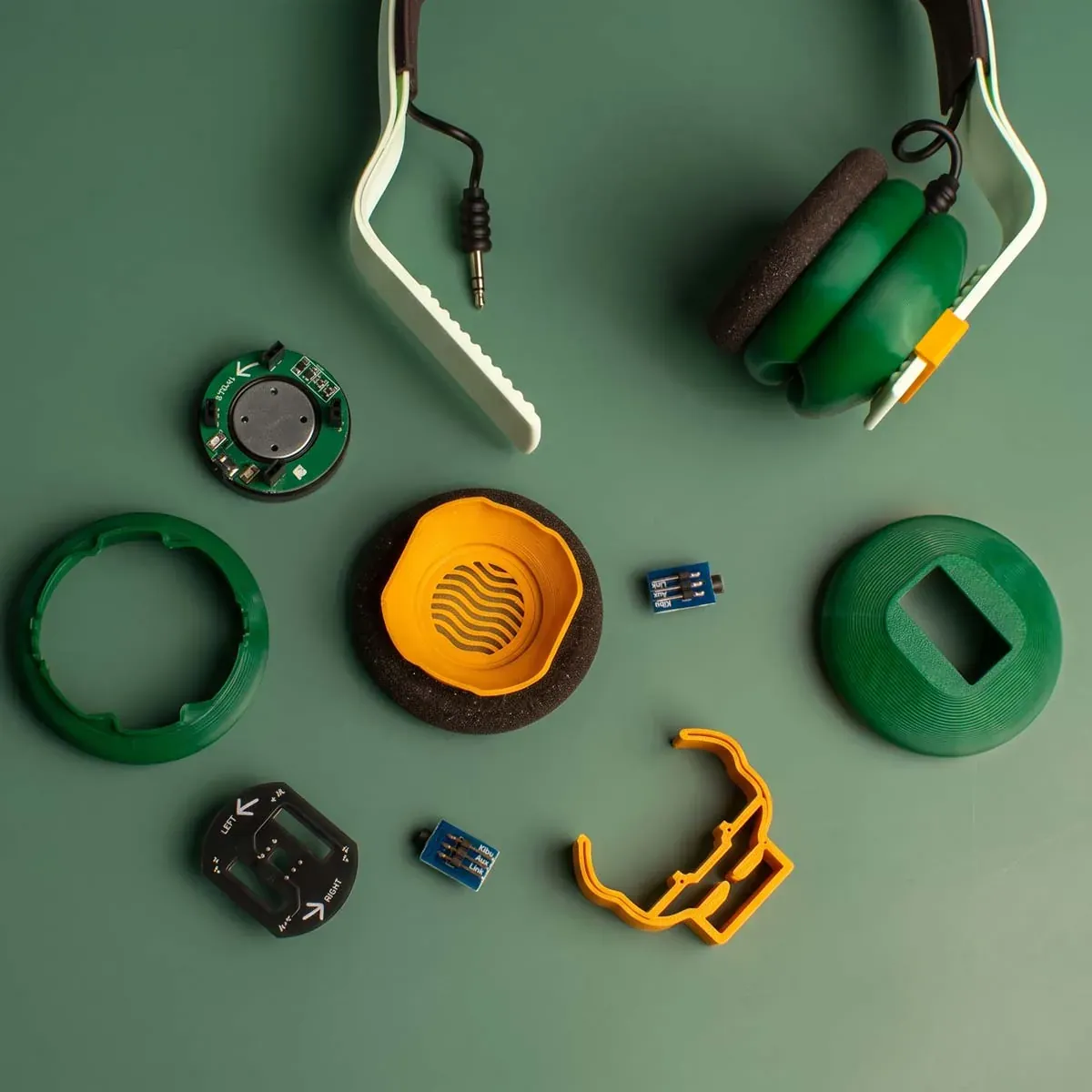
Every part of a Kibu pair can be replaced on its own. There are 12 parts on the repair parts page, from ear cushions, headband padding and clips to the main board and the speaker assembly, and most cost a few pounds. A breakage does not mean a new pair.
Is it made to order, or pulled from stock?
Each pair is made to order in our factory in London, so we do not hold large overstock. Production typically takes up to 5 working days before dispatch, and usually less.
What happens at the end of its life?
We take headphones back at the end of their life for recycling. Email contact@kibu.family and we will accept the pair back, as the delivery and returns page sets out.
What does it arrive in?
Packaging is cardboard and easily recyclable.
What is it made of, and will we say it plainly?
The main material is a bio-material that comes from plants like corn. We say it that way rather than using a chemical name, because the chemical name tells a parent nothing.
The claim we are most comfortable making is the boring one: every part can be replaced individually, so a breakage does not mean a new pair.
In June 2026, The Independent named Kibu the best sustainable headphones for kids in its kids' headphones roundup. That is a claim we would rather someone else made, and it is there for you to go and read.
Is a repairable pair really more sustainable than a cheap one?
Yes, in most cases, because making and shipping a whole new pair uses more than making one small part.
The cost of a cheap pair that breaks is not just the second pair. It is the parts, the box, the delivery and the old pair in the bin, repeated as many times as it breaks. We cannot put a number on the difference and we are not going to pretend to. But it is hard to see how replacing an entire headphone is the lighter option.
The sustainability page sets out what we can and cannot say about our own materials, and there is plenty we are still improving.
Do I need to be able to fix it myself?
No. You need to be able to find the broken part and fit the new one, and the step-by-step build video shows how.
Most repairs are a part out and a part in, with no screws and no glue. A grown-up can do it, and often the child does it, because they built the pair in the first place and already know where each part sits.
If you would rather not think about repairs at all, Kibu Care is optional cover for accidental damage and functional failure, including free replacement parts, with shipping fees possibly applying. It sits on top of your consumer rights, not instead of them.
What age is Kibu for?
Four and up, with a grown-up helping younger builders.
The age we design for most is 6 to 10, and that is where we hear the most from families. Younger children can build and use a pair with a trusted adult nearby. Below 3 we cannot recommend them, and the warning on the box says why.
Every pair also limits the volume to a safe level.
WARNING: Contains small parts. Not suitable for children under 3 years old. The cable may pose a strangulation risk. Always supervise young children during use.
Will it work with the things we already have?
Yes, if the thing has a 3.5mm headphone port.
That covers every Nintendo Switch, the Yoto Player and Yoto Mini, the first generation Toniebox, and most tablets and laptops. Phones and iPads without a headphone port work with a small adapter: USB-C for iPhone 15 and later, Lightning for iPhone 7 to iPhone 14.
Kibu headphones are wired, so they do not connect over Bluetooth. The one device we know does not work is the Toniebox 2, which has no headphone port. Which devices work with Kibu headphones has a table for every device we have tested.
Is it worth it if it lasts?
It can be, if the alternative is buying two or three cheap pairs.
We cannot tell you how many years a pair will last, and we will not guess at a number. What we can say is that a pair you can repair does not have to be replaced the first time something goes wrong, and that is usually the point at which a cheap pair is thrown away.
That is also why the headphones arrive as a kit. When a child builds something themselves, they look after it differently, and when it needs a part, they know where that part goes.
Where to start
If the checklist above is the one you would use, have a look at how it works in practice. Every Kibu pair is a kit your child builds, every part can be replaced on its own, and each pair is made to order in our factory in London.
Sam Beaney
Founder and CEO, Kibu
Sam Beaney is the founder and CEO of Kibu, the headphones children build, repair and keep. Sam pitched Kibu on BBC’s Dragons’ Den in February 2026.